Regular maintenance keeps your mixing and homogenising plant available and prevents unplanned downtime. We service homogenisers at our factory in Weyhe – usually within 2–3 weeks, from 5 working days with advance planning – or on site at your plant. We work with first-hand design knowledge: homogenising technology has been part of our family for more than 45 years (our history).
Maintenance at our factory
Send us your homogeniser unit. At our factory in Weyhe we inspect, service and overhaul it and prepare it for its next use. On request, we also overhaul the electric motor.
The usual lead time is about 2–3 weeks. With advance planning, maintenance can be completed in as little as 5 working days – provided there is no major damage. This lets you plan your plant downtime reliably.
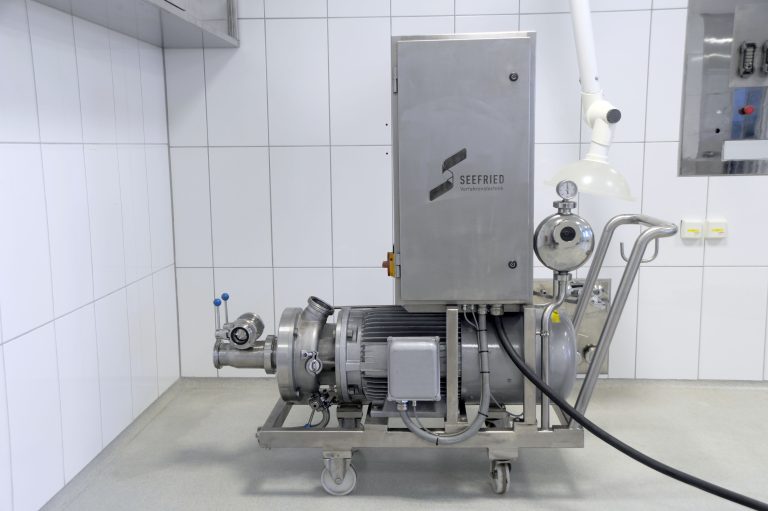
How maintenance at our factory works
- Schedule: we agree on the timing so maintenance fits your production window.
- Shipping: you send the homogeniser unit to Weyhe.
- Inspection and maintenance: we inspect the unit and carry out maintenance and repairs, including the mechanical seal.
- Optional motor overhaul: on request, we also overhaul the electric motor.
- Return: the unit is shipped back to you ready for use.
On-site maintenance
If removal or shipping is not practical, we come to you and maintain homogenisers and machines directly at the plant – in Germany and worldwide. We schedule the visit around your production.
Mechanical seal service
The mechanical seal is one of the most important wear parts of a homogeniser: it seals the shaft against the product chamber. Replacing it in time protects your product and prevents consequential damage to shaft and bearings.
Replacement & installation
- Removal of the worn mechanical seal
- Installation and adjustment of the new seal
- At our factory or on site
Refurbishment & repair
- Inspection of used mechanical seals
- Refurbishment where technically sensible
- Economical alternative to a new part
Spare parts
- Mechanical seals and wear parts
- Matched to your homogeniser
- Fast procurement
Barrier fluid system
- Inspection and repair
- Cooling and monitoring
- Matched to the mechanical seal
Replace the shaft at the same time
If the mechanical seal leaks, the homogeniser is dismantled and a new seal is fitted. The shaft should be replaced at the same time: with age, the shaft can become unbalanced, and it wears in the area of the seal. On an old shaft, the new seal would have a much shorter service life.
For homogenisers from Vakumix and NETZSCH Vakumix we supply compatible mechanical seals in all standard sizes (shaft Ø 20 to 45 mm) as well as shafts: Mechanical seals for Vakumix homogenisers
Typical signs of a worn mechanical seal
- Leakage at the shaft or around the homogeniser
- Unusual consumption or discolouration of the barrier fluid
- Noticeable noise or rising temperature at the seal
- Long running time since the last seal change
More services: Repair & troubleshooting · Modernisation & retrofit · all services
Mechanical seals by shaft Ø
Barrier fluid system: 3 checks before every start
The double-acting mechanical seal of a homogeniser works with a barrier fluid system. Check it before every machine start and at every handover from one machine operator to the next:
- Pressure: Is the pressure within the range specified by the manufacturer? Around 3 bar at 20 °C is typical. If the pressure drops, the system is leaking.
- Level: Is there enough barrier fluid, or has the plant lost barrier fluid?
- Colour: Is the barrier fluid unchanged? Discolouration indicates that product has entered the barrier fluid system.
Automatic monitoring systems are available for pressure and level and warn you of deviations. Depending on the application, barrier fluid systems are additionally cooled, circulated by a pump or can be sterilised. If one of the three checks shows something unusual, contact us: we inspect the system, replace leaking mechanical seals and advise you on suitable monitoring.
Frequently asked questions
How long does homogeniser maintenance take?
Usually about 2–3 weeks at our factory. With advance planning and no major damage, from 5 working days.
Is the electric motor overhauled too?
On request, yes. Overhauling the electric motor is an option during maintenance at our factory.
When should a mechanical seal be replaced?
At the latest when there is leakage, unusual barrier fluid consumption or noise. A planned replacement during maintenance, before consequential damage occurs, is better.
Can a used mechanical seal be refurbished?
Often, yes. We inspect the seal and refurbish it where technically sensible. Otherwise we supply and fit a spare part.
Last updated: October 2026
All trademarks mentioned, in particular Vakumix and NETZSCH, are the property of their respective owners and are used solely to identify the products offered. This is not an offer from the manufacturer. SEEFRIED Verfahrenstechnik is an independent supplier and is not affiliated with these manufacturers; our spare parts are compatible parts, not original parts.